
Female Cat Behavior After Spaying: What to Expect Day by Day ?
 By Pet Care Daily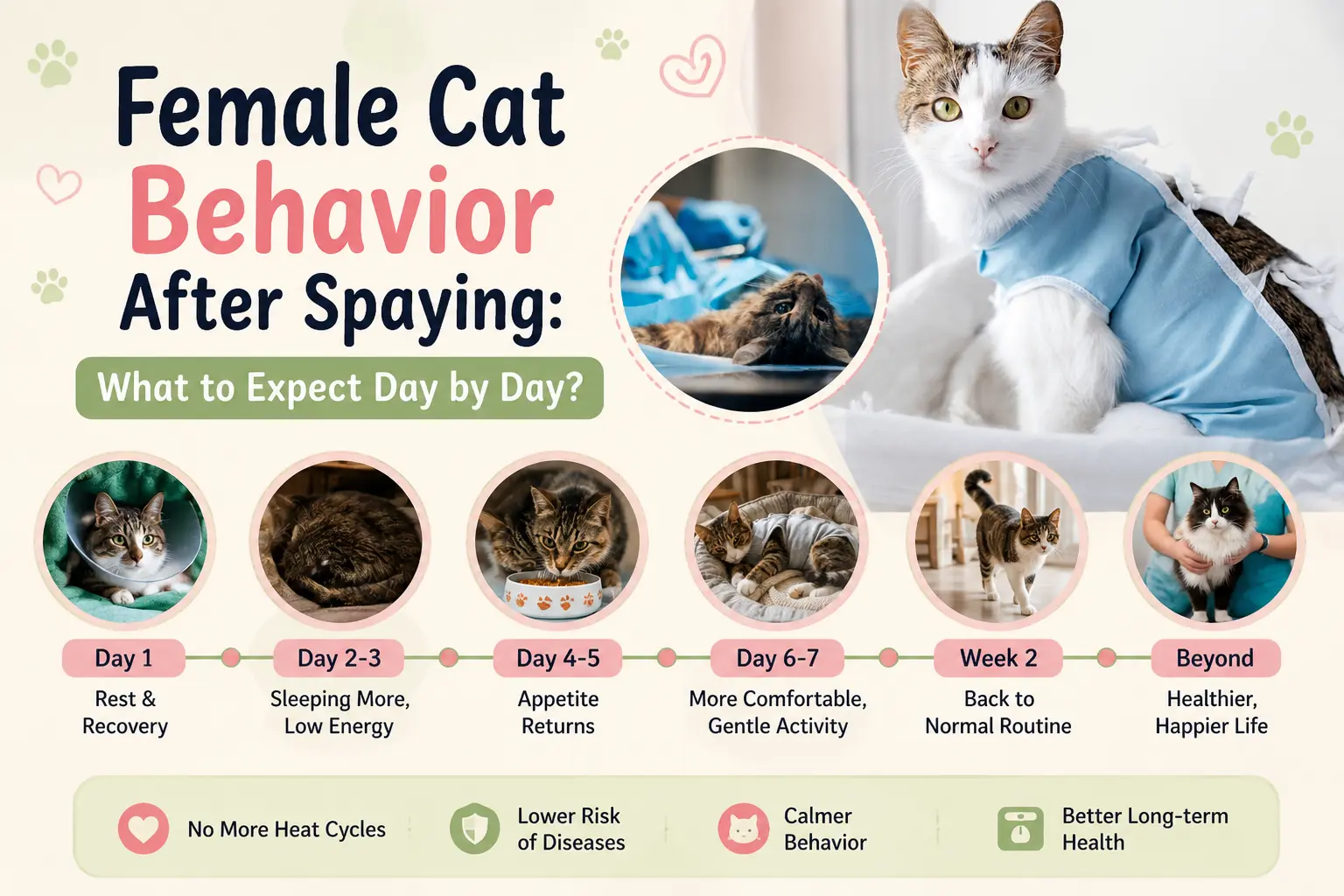
Female Cat Behavior After Spaying Introduction
If your cat seems different after being spayed, you’re not imagining it. It’s one of the most common questions new cat owners ask. The honest answer: it depends on the cat.
Some cats turn into total cuddle bugs, following their owner from room to room. Others pull back for a while and want more space. Many don’t change much at all. All three are normal.
What’s really going on is mostly hormonal. Spaying stops the hormone swings that drive heat cycles, so a lot of the “before and after” difference is really her hormones settling down, not a new personality taking over. Some of it is also just her growing up, since spaying often happens around the same time a cat would naturally be maturing anyway.
There’s a difference between that kind of change and simple healing. Grogginess or crankiness in the first day or two after surgery is normal. If she’s still withdrawn, not eating, or low on energy after two weeks, that’s worth a call to your vet.
Below, we’ll cover what commonly changes, what usually doesn’t, and how to tell normal recovery from something that needs attention.
🐱
Quick Answer
Most cats act a little different after being spayed, and that’s almost always normal.
The surgery stops the hormone swings from heat cycles, which is why many owners notice
calmer, less restless, or more affectionate behavior within a few weeks.
- 1Female Cat Behavior After Spaying Introduction
- 2What Does Female Cat Behavior After Spaying Mean?
- 3Main Reasons Behind Female Cat Behavior After Spaying
- 4How Age At Spay Affects Behavior
- 5How It Affects Multi-Cat Households
- 6Personality Type Matters
- 7Anesthesia Hangover, Explained Properly
- 8Litter Box Behavior
- 9Does Spaying Change Litter Box Habits, Marking, or…
- 10Why Cats Get Clingy (and What to Do…
- 11A Clear Before/After Comparison
- 12Kitten Recovery vs. Adult Cat Recovery
- 13A Kitten Heals and Behaves Differently Than a…
- 14Busting the "Spaying Changes Her Personality Forever" Myth
- 15Will Spaying Change Her Personality Forever?
- 16Normal Behavior vs. Concerning Behavior
- 17When Should You Ignore This Behavior?
- 18When Should You Reward or Respond to It?
- 19Practical Steps to Reduce Excessive Behavior Without Hurting…
- 20Age-Specific Advice for Kittens, Adult Cats, and Senior…
- 21Breed and Individual Personality Differences
- 22Real-Life Owner Examples and Reported Solutions
- 23Myth vs. Fact
- 24When It May Signal a Medical or Behavioral…
- 25Sudden Behavior Changes
- 26Pain or Physical Discomfort
- 27Vision or Hearing Changes
- 28Cognitive Dysfunction in Senior Cats
- 29Seizures or Neurological Warning Signs
- 30Quick Checklist Before Calling a Vet or Trainer
- 31When to Contact a Veterinarian or Professional Cat…
- 32Frequently Asked Questions
- 33Why Did My Cat Go From Avoiding Everyone…
- 34Can Spaying Change an Aggressive Rescue Cat's Behavior?
- 35Is It Normal for a Playful Kitten to…
- 36What If My Cat Becomes a Total Recluse…
- 37Why Did My Cat Go From Wandering Off…
- 38What Changes After Spaying a Cat With a…
- 39What Happens When a Hyperactive Kitten Won't Slow…
- 40Is It Normal for a Cat to Go…
- 41Does Age at Spay Really Change How Much…
- 42Are There Long-Term Mood or Behavior Effects, or…
- 43Final Thoughts
Some cats become “velcro cats,” sticking closer to their owner than before.
Some cats want extra space for a week or two while they heal.
Marking, yowling, and tension with other cats often calm down.
Common in kittens spayed before their first heat.
Withdrawal, low appetite, or low energy lasting past two weeks means it’s time to call your vet.
💡
Key Takeaways
1
Spaying changes your cat’s hormones, not her core personality.
Traits like being playful, shy, bold, or affectionate generally stick around.
2
Results really do vary.
Some cats become clingier and more affectionate, some pull back and get quieter for a while, and some barely change at all. All of these are normal responses.
3
Age matters more than most people expect.
Cats spayed before their first heat cycle usually show little to no change. Cats spayed later, especially after multiple heat cycles, tend to show bigger shifts.
4
Day-one or day-two grogginess and crankiness
comes from anesthesia and healing, not a lasting personality change. Give it a day or two before drawing conclusions.
5
Temporary withdrawal for one to two weeks after surgery
is common and usually resolves on its own. If it continues longer, or comes with low appetite or low energy, check in with your vet.
6
Kittens need closer supervision during recovery than adult cats,
since their energy often comes back before their incision is fully healed. Keep jumping and climbing limited for a week to ten days.
7
Basic litter box habits typically stay the same,
though heat-related marking usually stops after spaying.
8
When in doubt, patience is usually the answer.
Most behavior changes settle within a couple of weeks to a couple of months. If something seems to be getting worse instead of better, that’s your cue to call the vet.
Remember: Every cat recovers at her own pace, so look for steady improvement rather than expecting an instant change.
What Does Female Cat Behavior After Spaying Mean?
just means the changes you might see in your cat once she’s recovered from surgery. It’s not one specific behavior — it’s a range of possible changes, and which ones show up depends on the cat.
The biggest driver is hormones. Before spaying, a female cat cycles through heat, which can bring yowling, restlessness, marking, or a strong urge to escape and find a mate. Spaying removes the ovaries, so those hormone swings stop. Once that pressure is gone, her everyday behavior often becomes more consistent.
For some cats, that means calmer, friendlier, more affectionate behavior — sometimes even a clingy “shadow” that follows you from room to room. For others, it means a quieter, more withdrawn phase, especially in the first couple weeks of healing. And for many cats, especially kittens spayed before their first heat, there’s barely any noticeable change at all.
None of these outcomes is right or wrong — they’re all normal. What matters most is knowing what to expect, so you can tell the difference between your cat settling into her personality and a sign that something needs a vet’s attention.
Main Reasons Behind Female Cat Behavior After Spaying
No More Heat Cycles
Heat cycles are hard on a cat’s body. They can bring yowling, restlessness, scratching at doors, and a strong urge to escape and find a mate. Spaying stops those cycles for good, which takes away a major source of stress from her daily life.
Less Territorial Pressure
Unspayed females often mark territory or act tense around other cats, especially in multi-cat homes. Many owners see that tension ease up once the hormonal drive behind it is gone.
Less Urge to Roam
The drive to escape and find a mate fades after spaying. Some cats who used to slip outside for hours become homebodies — and for a few, that shift shows up as extra closeness with their owner.
Grogginess is Healing, Not a New Personality
In the first day or two after surgery, grogginess, crankiness, or low energy comes from the anesthesia and incision pain wearing off — not a personality change. It should fade as she heals.
Age At Spay Matters
Kittens spayed before their first heat usually show little to no behavior change, since those hormonal patterns never fully kicked in. Adult cats spayed after several heat cycles tend to show bigger shifts, since there’s more hormonal history to settle down from.
Her Personality Stays the Same
Surgery changes her hormones, not who she is. A shy cat will likely stay reserved; an outgoing cat will likely stay outgoing. Spaying smooths out hormone-driven behavior — it doesn’t rewrite her personality.
How Age At Spay Affects Behavior
Age plays a bigger role than most people expect.
Kittens spayed before their first heat cycle usually show little to no personality change. They haven’t gone through a hormonal cycle yet, so there’s nothing dramatic for the surgery to reverse. The most common difference owners notice is less territorial behavior.
Adult cats spayed later, especially after several heat cycles, tend to change more. Repeated heat cycles take a toll on a cat’s body and mood, often leading to yowling, restlessness, or even destructive behavior. Once those cycles stop, many owners see their cat become steadier and calmer.
Some owners describe this less as a change and more as their cat finally maturing. Her hormones are settling down around the same time she’d naturally be growing into her adult personality anyway.
Both patterns are normal. There’s no single “right” outcome—every cat adjusts on her own timeline.

How It Affects Multi-Cat Households
If you have more than one cat, spaying can change how they get along.
Before surgery, hormones often drive territorial behavior. A female cat may guard her space, hiss at housemates, or seem tense, especially during heat cycles. Once she’s spayed, that hormonal pressure goes away.
Many owners notice less friction in the house afterward. One owner saw their cat’s standoffs with another cat ease up noticeably after the spay, with much less hissing and posturing.
That said, relationships between cats won’t always improve overnight. Personality plays a role too, and some tension comes from normal cat dynamics rather than hormones. Still, less hormone-driven guarding is a common and expected change.
Give your cats time to adjust to their new dynamic. If tension continues or gets worse weeks after surgery, mention it to your vet—it may point to something unrelated to the spay.
Personality Type Matters
Spaying doesn’t affect every cat the same way. A lot depends on who your cat already is.
Some cats get more affectionate and want to be close to you all the time. Others pull back a little and want more space. Plenty of cats show almost no change at all, staying just as playful or independent as they were before.
Owners with littermates sometimes see this side by side. One cat might get noticeably clingier or more withdrawn after surgery, while her sibling acts exactly the same, even though both had the same procedure around the same time.
There’s no single “right” outcome to expect. Your cat’s natural personality—bold, shy, social, or independent—shapes how she acts afterward more than the surgery does.
If you’re ever unsure whether a change in your cat seems typical for her or feels more concerning, your vet can help you figure out the difference.

Anesthesia Hangover, Explained Properly
If your cat seems groggy, wobbly, or unusually quiet right after surgery, that’s not a personality change—it’s the anaesthesia wearing off.
Anaesthesia affects her whole body, not just the surgery site. It’s normal for cats to seem sleepy, clumsy, or a little confused for the first 24 hours. Some also get cranky or want to be left alone, which usually comes from grogginess or pain rather than any real shift in who they are.
This is where a lot of the “spaying changed her personality” worry starts. Short-term grogginess and healing discomfort can look a lot like a lasting change, even though they’re not the same thing.
Give it a day or two. Most cats are back to their usual selves once the anaesthesia clears and the initial soreness fades.
If your cat still seems “off,” won’t eat, or seems to be in pain after a couple of days, that’s a good reason to call your vet.
Litter Box Behavior
A lot of owners wonder if spaying changes litter box habits. For most cats, it doesn’t.
Regular box use, digging, and covering usually stay the same before and after surgery. If your cat was already using the box consistently, that habit typically sticks.
What can change is spraying or marking tied to heat cycles. Cats in heat sometimes mark territory more than usual. Once she’s spayed and her hormones settle, that kind of marking often fades.
Right after surgery, expect a short adjustment period. Some cats are briefly less interested in using the box simply because they’re sore or groggy from the incision. This usually clears up within a few days as she heals.
It’s also worth checking that your regular litter isn’t irritating her incision. Clumping litter can stick to the area, so many vets recommend switching to a soft, low-dust litter during recovery.
If accidents outside the box continue past a week or two, or your cat seems to strain or act uncomfortable, check in with your vet.
Does Spaying Change Litter Box Habits, Marking, or Accidents?
This is one of the most practical questions owners have, and it rarely gets a clear answer.
For most cats, spaying doesn’t change basic litter box habits. If your cat already used the box reliably, she’ll likely keep doing so after surgery.
Marking is a different story. Cats in heat sometimes spray or mark more because of hormones. Once she’s spayed, that urge to mark usually fades since it’s no longer being triggered.
Accidents outside the box are usually tied to recovery, not a lasting change in habits. In the first day or two, some cats skip the box simply because they’re sore, groggy, or uncomfortable moving around. This typically clears up on its own within a few days.
If accidents continue past a week or two, or you notice straining, crying, or blood in the urine, that’s not typical post-surgery behavior. Contact your vet—it could point to a urinary issue unrelated to the spay.
Why Cats Get Clingy (and What to Do About It)
Some cats turn into total “velcro cats” after spaying, sticking close to their owner and following them from room to room. If this is happening to your cat, you’re not imagining it.
Many owners notice this same pattern: a cat that used to wander off or nap alone for hours suddenly wants constant closeness, waiting by doors or nudging for attention. One common theory is that spaying reduces the natural urge to roam and search for a mate, so that energy gets redirected toward their favorite person instead.
This kind of clinginess is normal. It doesn’t mean anything is wrong, and most owners end up enjoying the extra affection.
If you’d like to help her build a little independence, try short, positive stretches apart. Leave her with a favorite toy or a cozy spot by a window, and increase alone time gradually instead of all at once.
Clinginess only becomes a concern if it comes with stress signs like excessive crying, loss of appetite, or hiding. If that happens, check in with your vet.
A Clear Before/After Comparison
Here’s a simple way to picture what usually changes, and what doesn’t.
Before spaying, many cats go through heat cycles that bring yowling, restlessness, and a strong urge to escape outside. Some get more territorial, marking or acting tense around other pets. Energy levels often swing with the cycle—sweet one week, edgy the next.
After spaying, once recovery is done, those hormone-driven swings typically stop. Many owners notice steadier moods, less yowling, and calmer day-to-day behavior. Territorial tension in multi-cat homes often eases too.
What usually stays the same is your cat’s core personality. A social cat generally stays social. An independent cat generally stays independent. Spaying clears out the hormonal noise, but it doesn’t rewrite who she is underneath it.
Some cats do become more affectionate or clingy, and a smaller number get more withdrawn for a while. Both are normal reactions—results really do vary from cat to cat.

Kitten Recovery vs. Adult Cat Recovery
A kitten’s recovery doesn’t always look like an adult cat’s, and that catches a lot of first-time owners off guard.
Kittens tend to bounce back fast—sometimes too fast. Their high energy makes it hard to slow down and rest, even with a healing incision. One rescue kitten kept jumping and climbing right after her spay despite wearing a recovery suit, which led to a swollen incision and an emergency vet visit. That’s why vets often recommend closely limiting jumping and climbing for a week to ten days, even if your kitten seems totally fine.
Adult cats tend to go the other way. They usually rest more naturally after surgery and settle into recovery without much prompting. Any grogginess or crankiness in the first day or two is typically just leftover anesthesia and healing discomfort, not a lasting change.
If your kitten seems unusually swollen, in pain, or won’t calm down during recovery, don’t wait it out—call your vet the same day.
A Kitten Heals and Behaves Differently Than a Full-Grown Cat
This part often gets lumped together in other guides, but kittens and adult cats really don’t recover the same way.
A kitten’s body heals fast, and so does her energy. The problem is her energy often comes back before the incision fully heals. She may want to run, jump, and play like nothing happened, even though the surgery site still needs time. That mismatch is exactly why kittens are more likely to overdo it during recovery.
A full-grown cat tends to heal on a steadier timeline. Her energy and her incision usually recover at a similar pace, so she’s less likely to push past her limits.
This difference matters for how closely you need to watch each one. A kitten needs more active supervision and confined space during recovery, while an adult cat often manages her own limits more naturally.
Neither pattern is a personality problem—it’s just biology. Knowing the difference ahead of time helps you plan recovery around your cat’s actual age, not a one-size-fits-all timeline.

Busting the “Spaying Changes Her Personality Forever” Myth
This is one of the biggest fears new owners have, so let’s answer it directly: spaying does not permanently rewrite your cat’s personality.
What actually changes is her hormones, not who she is at her core. The stress, restlessness, and territorial behavior tied to heat cycles go away. But her natural traits—playful, shy, bold, or affectionate—generally stay the same.
The confusion usually comes down to timing. Grogginess or crankiness on day one or two is from anesthesia and healing, not a personality shift. Some owners mistake this short recovery phase for a lasting change, when it’s really just her body bouncing back.
A smaller number of cats do show real shifts—more affectionate or more withdrawn—but this is the exception, not the rule. It usually comes from hormones settling or the cat naturally maturing, not the surgery reshaping her.
If your cat still seems different weeks after healing, talk to your vet to rule out anything else going on.
Will Spaying Change Her Personality Forever?
Most guides answer this fear with a single line buried in an FAQ. It deserves better, since it’s one of the top worries new owners have.
Here’s the straight answer: no, spaying does not permanently change who your cat is.
What it does change is her hormones. The restlessness, yowling, and territorial behavior tied to heat cycles go away, since there’s no more hormonal cycle driving them. Her core personality—playful, independent, shy, or affectionate—generally stays intact.
Some cats do show noticeable shifts, becoming more affectionate or a bit more withdrawn for a while. That’s real, and it happens. But it’s the exception, not the rule. It’s usually tied to hormones settling or your cat naturally maturing, not the surgery reshaping her from the ground up.
If your cat still seems like a different cat weeks after she’s fully healed, that’s worth a conversation with your vet, just to rule out anything else going on.
Normal Behavior vs. Concerning Behavior
Most changes after spaying fall well within normal range, but it helps to know the difference between “settling in” and “something’s wrong.”
Normal behavior after spaying:
- Grogginess, wobbliness, or sleeping more for the first 24 hours
- Mild crankiness or wanting to be left alone for a day or two
- Less yowling, marking, or restlessness as hormones settle
- Becoming more affectionate and clingy
- Becoming a bit more withdrawn for one to two weeks, then gradually returning to normal
- Less tension with other cats in the house
Signs worth watching more closely:
- Swelling, redness, or discharge at the incision site
- Refusing to eat for more than a day
- Vomiting, diarrhea, or visible pain beyond the first couple of days
- Straining in the litter box, or blood in the urine
- Withdrawal or low energy that doesn’t improve after two weeks
- Non-stop jumping or climbing right after surgery, which can strain the incision
A good rule of thumb: short-term changes tied to healing usually get better day by day. If something seems to be getting worse instead of better, or your cat seems to be in real pain, call your vet instead of waiting it out.
Decision Chart: Normal vs. Concerning Signs
If you’re not sure how to read what your cat is doing right now, use this quick guide.
| What You Notice | Status | What To Do |
|---|---|---|
| Sleepy, wobbly, or quiet on day one |
✓ Normal |
This is the anesthesia wearing off. Let her rest in a calm, quiet space. |
| Cranky or avoiding touch for a day or two |
✓ Normal |
She’s likely sore, not upset with you. Give her space and check in gently. |
| Clingier than usual, following you everywhere |
✓ Normal |
Many cats seek more closeness after spaying. Enjoy it, or offer short, positive breaks apart if you’d like her to stay a bit more independent. |
| Withdrawn or hiding for one to two weeks |
⚠ Usually Normal |
Usually normal, especially right after surgery. Watch for gradual improvement. |
| Withdrawal that continues past two weeks, or comes with low appetite |
⚠ Concerning |
Time to call your vet. This goes beyond typical healing. |
| Incision looks swollen, red, or has discharge |
⚠ Concerning |
Contact your vet. This isn’t a behavior issue—it’s a healing concern. |
| Straining in the litter box, or blood in the urine |
⚠ Concerning |
Contact your vet promptly. This isn’t part of normal recovery. |
| Totally fine and eager to run and jump right away |
⚠ Be Careful |
Keep her calm anyway. Too much activity early on can strain the incision, even if she feels great. |
When in doubt:
Trust your gut. A quick call to your vet beats guessing.
When Should You Ignore This Behavior?
Not every change after spaying needs a fix. Some behaviors are best left alone, since trying to “correct” them can add stress your cat doesn’t need.
If your cat becomes more affectionate and clingy, there’s no problem to address here. This is a common, harmless response, and most owners end up enjoying the extra closeness. If you’d like her to keep some independence, gentle, gradual alone time works better than pushing her away.
If she seems a little quieter or more withdrawn in the first two weeks, let her set the pace. She doesn’t need extra attention forced on her, and she doesn’t need to be left completely alone either. Just give her the option to come to you.
If she’s cranky or avoids being picked up for a day or two after surgery, don’t take it personally and don’t push through it. This is normal soreness, not a behavior problem to train away.
The one thing you shouldn’t ignore is high energy right after surgery. Even if your cat seems totally fine and wants to play, jump, or climb, keep her calm and confined for a week to ten days. That’s not a personality quirk to overlook—it’s a real risk to her incision.
When Should You Reward or Respond to It?
While some behaviors just need patience, others benefit from a little extra attention from you.
If your cat is quiet or withdrawn in the first day or two, gentle, low-pressure responses work best. Soft talking, a warm blanket, and letting her rest without crowding her can help her feel safer while she heals. You don’t need to coax her out—just make it easy for her to come to you when she’s ready.
If she’s clingier than usual, respond with calm affection rather than excitement. A steady, quiet routine helps her feel secure without ramping things up. Petting, sitting nearby, and letting her settle on your lap are all good responses.
If she’s regaining energy and wants to play a few days into recovery, offer calm, low-impact engagement instead of full play sessions. Slow petting or a soft toy she can bat at while lying down keeps her occupied without encouraging jumping or running.
One thing worth rewarding directly is calm behavior during recovery. If she settles down on her own instead of trying to jump or climb, quiet praise and gentle petting reinforce that choice—and support her healing at the same time.
Practical Steps to Reduce Excessive Behavior Without Hurting Your Bond
If your cat’s clinginess, restlessness, or other behavior feels like a bit much, you can gently guide it back without pushing her away.
Build short breaks into her day. If she’s glued to your side, start with a few minutes apart in another room with a toy or cozy bed. Slowly stretch that time out. This teaches her that alone time is safe, not scary.
Keep her routine steady. Feeding, play, and quiet time at consistent hours help her feel secure. A predictable day often does more to reduce clingy or anxious behavior than any single trick.
Give her outlets for energy. A few short play sessions with a wand toy or ball can help burn off restlessness, especially once she’s fully healed and cleared for normal activity.
Avoid punishing clinginess or withdrawal. Scolding or pushing her away can damage trust and often makes the behavior worse, not better. Calm redirection works far better than correction.
Limit activity during early recovery. If she’s overly energetic right after surgery, confine her to a smaller space with a litter box, food, and water nearby. This keeps her calm without needing constant supervision.
Small, consistent steps like these help balance her behavior while keeping your bond intact.
Age-Specific Advice for Kittens, Adult Cats, and Senior Cats
Kittens tend to heal fast, sometimes too fast for their own good. Their energy can come back before the incision is ready for it, so close supervision matters. Keep jumping and climbing limited for a week to ten days, even if she seems full of energy right away. If she was spayed before her first heat cycle, expect little to no personality change, just less territorial behavior as she grows.
Adult cats often show bigger behavior shifts, especially if they went through several heat cycles before surgery. Expect a calmer, steadier mood once hormones settle, though full behavioral stabilizing can take a couple of months, not just days. Recovery pacing tends to come more naturally at this age, with less risk of overdoing activity too soon.
Senior cats generally heal well too, but recovery may take a bit longer, and any grogginess or soreness might linger a day or two more than in younger cats. Watch closely for changes in appetite or energy, since older cats can have other health factors at play. If anything seems off beyond typical healing, don’t wait—a quick vet check is the safest move.
No matter her age, patience during the first couple of weeks makes the biggest difference in how smoothly she settles back into herself.
Breed and Individual Personality Differences
Genetics and personality play a bigger role in post-spay behavior than most people expect.
Some cats are naturally social and affectionate to begin with, and they often lean into that even more after spaying, becoming outright velcro cats. Others are wired to be more independent or reserved, and that tendency can show up as a quieter, more withdrawn phase after surgery.
This is why two cats from the same litter can react so differently to the same procedure. One owner noticed her female cat became withdrawn and stopped seeking affection after her spay, while her brother, neutered around the same time, stayed exactly the same playful goofball he’d always been. Same surgery, same household, two completely different outcomes.
Breed tendencies can play a small role too. Naturally high-energy or vocal breeds may take a bit longer to settle after surgery, simply because that’s closer to their baseline. But this varies a lot from cat to cat, and individual personality usually matters more than breed alone.
The takeaway: there’s no universal script for how your cat will act after spaying. Her own temperament, more than anything else, shapes what you’ll actually see.

Real-Life Owner Examples and Reported Solutions
Hearing how this played out for other cats can be reassuring, even though every cat is different. These stories come from pet owners online, so treat them as personal experiences rather than medical advice.
One cat used to hide on top of the kitchen cabinets and only came down to eat. After spaying, she started sleeping on the bed, letting her owner hold her, and reportedly purred for the first time in five years. Her owner said the biggest factor was simply giving her time—the change built up gradually over days and weeks, not overnight.
Another owner described a once-hostile rescue cat who used to hiss and scratch. After being spayed as an adult, she became affectionate enough to run to the door and jump into laps for cuddles. In that case, patience had already built the bond over years, and spaying seemed to remove a layer of stress that had been in the way.
Not every story is about a cat opening up. One owner said her cat became withdrawn and stopped seeking affection after her spay, while her littermate brother stayed exactly the same playful goofball. She didn’t try to fix it—just gave her cat space and gentle attention, and that was enough.
These differences are normal. Results really do vary from cat to cat.
Myth vs. Fact
There’s a lot of mixed information out there about spaying and behavior. Here’s a clear breakdown.
Myth: Spaying permanently changes your cat’s personality.
Fact: Spaying changes her hormones, not who she is at her core. Traits like being playful, shy, bold, or affectionate generally stick around.
Myth: Every cat gets calmer and sweeter after spaying.
Fact: Most cats do become calmer as hormone-driven stress fades, but not all. Some get clingier, some pull back for a while, and some barely change at all. Results really do vary.
Myth: If your cat seems “off” the day after surgery, that’s the new normal.
Fact: That’s almost always anesthesia and healing discomfort, not a lasting shift. Most cats bounce back within a day or two.
Myth: Age doesn’t matter.
Fact: It does. Cats spayed before their first heat cycle usually show little to no change. Cats spayed later, especially after several heat cycles, tend to show bigger shifts.
Myth: A withdrawn cat after surgery means something is wrong.
Fact: Temporary withdrawal for one to two weeks is common and usually resolves on its own. If it lasts longer or comes with low appetite, that’s when a vet visit makes sense.
Knowing the difference between what’s really happening and what’s just internet rumor can save you a lot of unnecessary worry.
When It May Signal a Medical or Behavioral Problem
Most changes after spaying settle down on their own, but a few signs mean it’s time to get your vet involved rather than wait things out.
Physical warning signs matter most in the first couple of weeks. Swelling, redness, or discharge at the incision site isn’t normal healing—it needs to be checked. The same goes for straining in the litter box, blood in the urine, vomiting, or a loss of appetite lasting more than a day. These point to something medical, not just behavior settling.
Behavioral signs are trickier, since some withdrawal and low energy is expected early on. But if your cat is still hiding, avoiding affection, or seems low-energy two weeks or more after surgery, that’s outside the typical healing window. It’s worth a vet visit to rule out pain, infection, or another medical cause before assuming it’s just personality.
Sudden aggression is another sign not to brush off. Occasional crankiness during healing is normal, but ongoing aggression toward people or other pets weeks later isn’t a typical spay response and deserves a proper look.
The general rule: temporary changes tied to healing tend to improve steadily. If something is staying the same or getting worse instead of better, that’s your cue to call the vet.
Sudden Behavior Changes
A sudden shift right after surgery usually has a simple explanation: hormones, healing, or both.
If your cat seems like a different cat overnight—more affectionate, more clingy, or more withdrawn—it’s often because the hormonal stress driving her old behavior has finally lifted. One owner described her cat becoming a “shadow” who never left her side after surgery, a stark change from a cat that used to disappear for a full day at a time.
The key is “sudden” versus “gradual.” Most real behavior settling happens gradually over days to weeks, not instantly. If a change shows up within the first 24 to 48 hours, it’s more likely tied to anesthesia or pain than a true personality shift.
A sudden change that includes aggression, extreme fear, or a total refusal to eat is different. That combination goes beyond normal adjustment and is worth a same-day call to your vet.
Pain or Physical Discomfort
Some of the behavior changes owners notice right after spaying aren’t really about mood at all. They’re about pain.
A sore incision can make a cat avoid being picked up, flinch when touched near her belly, or seem unusually still and quiet. This isn’t her personality shifting—it’s simply her body telling her to move less and protect the area while it heals.
Crankiness fits here too. A cat who snaps or pulls away when handled in the first day or two is often reacting to discomfort, not to you. This typically eases as the incision heals and any pain medication does its job.
Vets prescribe pain control after spaying specifically because managing this discomfort matters, both for comfort and for keeping your cat from overexerting the area.
If pain-related behavior doesn’t ease up after a few days, or your cat seems to be in more pain rather than less, check in with your vet. That’s a sign something may need a closer look.
Vision or Hearing Changes
Spaying itself does not affect a cat’s vision or hearing. The surgery involves the reproductive organs, not the eyes or ears, and anesthesia doesn’t cause any lasting sensory changes once it wears off.
If you notice your cat bumping into things, missing toys she used to catch easily, or not responding to sounds she normally would, don’t assume it’s related to the spay. This is more likely a coincidence, especially in older cats, where vision or hearing issues can develop around the same general life stage as spaying.
The one temporary exception is right after anesthesia. Some cats seem a little disoriented or slower to react for the first several hours as the sedation wears off. This is normal and should clear up within a day.
If vision or hearing changes continue beyond the immediate recovery window, treat it as its own issue and have your vet take a look—it’s not something spaying explains on its own.
Cognitive Dysfunction in Senior Cats
Spaying does not cause cognitive dysfunction. This condition is related to brain aging, not reproductive surgery, and it typically shows up in senior cats regardless of whether or when they were spayed.
If your cat is older and having her first spay later in life, it helps to know the difference between normal surgery recovery and separate age-related changes. Grogginess and quietness right after surgery are tied to anesthesia and healing, and they clear up within a day or two.
Cognitive dysfunction looks different. Signs include confusion, disrupted sleep patterns, increased nighttime vocalizing, or seeming lost in familiar spaces. These changes develop gradually over time and aren’t related to the spay itself.
If your senior cat shows these kinds of changes weeks or months after surgery, it’s not something the spay explains. That’s a separate conversation to have with your vet, since age-related cognitive changes are managed differently than post-surgery recovery.
Seizures or Neurological Warning Signs
Spaying does not cause seizures or neurological problems. This is a routine surgery involving the reproductive organs, and it doesn’t affect the brain or nervous system.
Some cats seem briefly wobbly, disoriented, or slow to respond in the hours right after anesthesia. That’s a normal, temporary effect of sedation wearing off, not a neurological issue. It typically clears up within several hours to a day.
True warning signs are different, and they’re not something to wait out. These include seizures, sudden collapse, disorientation that doesn’t improve, uncontrolled shaking, or difficulty walking that continues well past the anesthesia window.
If your cat shows any of these signs, especially more than 24 hours after surgery, treat it as urgent. Contact your vet right away, or go to an emergency clinic if your regular vet isn’t available. These symptoms point to something separate from normal spay recovery and need prompt medical attention rather than a wait-and-see approach.
Quick Checklist Before Calling a Vet or Trainer
Before you pick up the phone, run through this list to figure out what you’re actually dealing with.
Check the timeline:
- Less than 48 hours since surgery? Grogginess, quietness, and mild crankiness are expected. Give it time.
- One to two weeks out? Withdrawal or clinginess can still be part of normal adjustment.
- Two weeks or more with no improvement? This is outside typical healing and worth a call.
Check the incision:
- Clean, dry, and closed? Normal.
- Swollen, red, or leaking discharge? Call your vet.
Check appetite and energy:
- Eating, drinking, and moving around, even if a little slower than usual? Normal.
- Refusing food for more than a day, or unusually low energy that isn’t improving? Call your vet.
Check the litter box:
- Using it normally, maybe with a short adjustment period? Normal.
- Straining, blood in urine, or accidents continuing past a week or two? Call your vet.
Check for pain or distress:
- Some soreness and reluctance to be touched for a day or two? Normal.
- Crying, visible pain, or symptoms getting worse instead of better? Call your vet.
If most items check out as normal, patience is likely all your cat needs. If anything falls into the “call your vet” column, don’t wait it out—a quick call can rule out problems early and give you peace of mind.
When to Contact a Veterinarian or Professional Cat Behaviorist
Most behavior changes after spaying work themselves out with time. But a few situations call for outside help rather than waiting it out.
Contact your vet if:
- The incision looks swollen, red, or has any discharge.
- Your cat won’t eat for more than a day.
- She’s vomiting, has diarrhea, or seems to be in pain beyond the first couple of days.
- She strains in the litter box or you notice blood in her urine.
- Withdrawal, low appetite, or low energy continues past two weeks.
- She shows any signs of seizures, collapse, or ongoing disorientation.
These situations point to something medical, and a vet can rule out infection, complications, or other health issues that aren’t part of typical recovery.
Contact a professional cat behaviorist if:
- Clinginess or anxiety is intense enough to disrupt daily life for you or your cat.
- Withdrawn behavior continues well past healing with no medical cause found.
- Tension with other cats in the home doesn’t improve over time.
- You’re not sure whether what you’re seeing is behavioral or medical.
A behaviorist can help build a plan tailored to your cat, especially when personality, environment, or multi-cat dynamics are part of the picture.
When in doubt, start with your vet. They can rule out physical causes first and point you toward a behaviorist if needed.
Frequently Asked Questions
Will my cat’s personality change forever after spaying?
No. Her hormones change, but her core personality generally stays the same. Some cats do become more affectionate or more withdrawn, but that’s the exception, not the rule.
How long does it take for behavior to settle after spaying?
Physical healing usually takes about ten to fourteen days, but full hormonal settling can take a couple of months. Don’t expect an instant personality shift right after recovery.
Why is my cat suddenly so clingy?
This is common and normal. Many owners describe their cat becoming a “shadow” after spaying, likely because the hormonal drive to roam and find a mate is gone.
Is it normal for my cat to hide or avoid me after surgery?
Some withdrawal for one to two weeks is normal, especially while healing. If it continues longer or comes with low appetite, check in with your vet.
Does age at spay matter?
Yes. Cats spayed before their first heat cycle usually show little to no personality change. Cats spayed later, especially after multiple heat cycles, tend to show bigger shifts.
Will spaying change my cat’s litter box habits?
Not usually. Basic litter box habits typically stay the same. Heat-related marking often stops, and any accidents right after surgery are usually tied to short-term soreness, not a lasting change in habits.
Why Did My Cat Go From Avoiding Everyone to Completely Different After Spaying?
One owner online described exactly this: her cat used to avoid all contact and hide from everyone except one family member, then became a completely different cat after being spayed.
This kind of dramatic shift usually comes down to hormonal stress. A cat driven by the urge to find a mate or protect territory can stay on edge constantly, even around people she trusts. Once that hormonal pressure lifts, some cats visibly relax, becoming more open to contact and affection than they ever were before.
This change tends to build gradually over days or weeks, rather than happening overnight. It’s also more common in cats spayed as adults, especially after going through heat cycles, since there’s more hormonal stress to lift in the first place.
This kind of transformation is a normal, positive response. Not every cat reacts this dramatically, but when it happens, it’s a real and recognized pattern.
Can Spaying Change an Aggressive Rescue Cat’s Behavior?
One owner shared a story about a rescued stray who stayed aggressive and distant for years, then changed drastically after finally being spayed as an adult.
Stories like this aren’t unusual. A stray who spent years driven by survival instincts—protecting territory, avoiding threats, competing for mates—often carries a lot of hormone-fueled stress. Spaying removes that ongoing hormonal pressure, and for some cats, that’s enough to let a calmer personality finally come through.
Patience mattered here too. This kind of transformation in a formerly feral or aggressive cat often builds on a bond that was already forming before surgery, not created by the surgery alone. Spaying seems to remove a barrier rather than build the relationship from scratch.
Not every aggressive or distant cat will change this dramatically, and that’s okay too. But when it happens, it reflects a real, recognized pattern tied to hormones finally settling down.
Is It Normal for a Playful Kitten to Seem “Dull” After Spaying?
One owner asked this exact question after a vet tech warned her that her kitten’s personality might change post-spay. Her playful, energetic kitten seemed noticeably duller afterward, and she wasn’t sure if that was expected.
In most cases, this is temporary. Grogginess, low energy, and a quieter mood in the first day or two are tied to anesthesia and healing, not a permanent shift. Kittens especially can seem subdued right after surgery simply because their bodies are recovering, even if their usual energy is still in there.
Full hormonal settling can take longer, sometimes a couple of months, so don’t expect her old bounce back overnight. Most kittens gradually return to their playful selves as the incision heals and energy comes back.
If your kitten stays flat, uninterested in play, or low-energy well beyond two weeks, that’s worth mentioning to your vet, just to rule out anything else going on.
What If My Cat Becomes a Total Recluse After Spaying?
One owner described her once-playful cat becoming a recluse after spaying, no longer seeking affection and hiding in corners instead of interacting like she used to.
This kind of withdrawal does happen, and it’s honest to say it’s not the outcome most owners expect. While many cats become calmer or more affectionate, a smaller number pull away instead, especially in the first one to two weeks after surgery.
Some of this is simply healing. Soreness and grogginess can make a cat want to be left alone. But if the hiding and avoidance continue well past two weeks, it may be more than recovery—it could reflect her adjusting to the hormonal change, or something tied to her own personality.
Either way, this deserves gentle attention, not a fix. Give her quiet space, avoid forcing interaction, and keep offering calm affection on her terms. If the withdrawal doesn’t ease up, or comes with low appetite or low energy, check in with your vet to rule out anything medical.
Why Did My Cat Go From Wandering Off to Following Me Everywhere?
One owner described a cat that used to sneak off for up to 24 hours at a time and became a constant, clingy shadow after being spayed, following her everywhere and needing constant closeness.
This is a real and fairly common pattern. Before spaying, a cat’s urge to roam is often tied to searching for a mate or protecting territory outside the home. Once that hormonal drive is gone, some cats simply have less reason to wander—and more interest in staying close to the person they trust most.
This isn’t something to worry about. It’s a normal response, and many owners end up enjoying the extra affection. If you’d like her to keep some independence, you can build in short, positive periods apart rather than discouraging the closeness altogether.
If the clinginess ever comes with signs of distress, like excessive crying or refusing to eat, that’s worth mentioning to your vet.
What Changes After Spaying a Cat With a History of Constant Heat Cycles?
One owner adopted a 4-year-old cat from a neglectful home who had gone through constant heat cycles, with yowling, scratching, and marking, before finally being spayed. She wanted to know what would actually change.
For cats with a long history of repeated heat cycles, spaying often brings noticeable relief. Heat cycles are physically and emotionally taxing, and back-to-back cycles without breaks can leave a cat in a near-constant state of hormonal stress.
Once that cycle stops, many owners see the intense behaviors tied to heat—yowling, scratching, restlessness, marking—fade out completely. Calmer, more even-tempered behavior that used to show up only between heat cycles can become her everyday normal instead of the exception.
This kind of change tends to build gradually rather than happen overnight, and full stabilizing can take a couple of months. Given this cat’s rescue background, patience and a calm routine make a real difference in how smoothly she settles in.
What Happens When a Hyperactive Kitten Won’t Slow Down After Spaying?
One owner shared a cautionary story: her kitten, spayed at 6 months old, stayed just as hyperactive right after surgery as before it. She kept jumping and moving so much that her incision area became swollen, leading to an emergency vet visit.
This is a real risk, especially with young, high-energy kittens. A kitten’s energy often bounces back before her incision is actually ready for it, and unlike adult cats, kittens don’t always slow themselves down naturally during recovery.
This is exactly why vets recommend limiting jumping, climbing, and rough play for about a week to ten days after surgery, even if your kitten seems totally fine. “Seeming fine” isn’t the same as being fully healed underneath.
If your kitten won’t settle down, closer supervision, a smaller confined space, or a vet-approved plan to help her relax can prevent this kind of setback. If swelling, redness, or discharge does show up at the incision site, treat it as urgent and contact your vet right away.
Is It Normal for a Cat to Go Quiet for Two Weeks After Spaying?
One owner’s cat, spayed at 6 months old after already going through two heat cycles, went quiet and distant for about two weeks after surgery. She wanted to know if that was normal.
In most cases, yes. Temporary withdrawal in the two weeks after spaying is a common pattern, especially in cats who were already sexually mature before surgery. Some of this comes from healing itself, and some from hormones gradually settling down.
This is a good example of the difference between short-term recovery and a lasting personality change. A quiet, distant phase that improves over roughly two weeks usually means your cat is adjusting, not changing who she is. Many owners describe their cat returning to normal, sometimes even calmer and more confident, once this window passes.
If the quietness continues well past two weeks, or comes with a loss of appetite or energy, that’s the point to check in with your vet rather than continuing to wait it out.
Does Age at Spay Really Change How Much Behavior Shifts?
Multiple owners have compared notes online about spaying kittens before their first heat cycle versus spaying older cats, all asking the same question: does age actually affect how much behavior changes?
The pattern that keeps showing up is consistent. Cats spayed before their first heat cycle tend to show little to no noticeable personality change, since the hormonal shift that comes with maturity never really got started. One owner’s kitten, spayed at 5 months old, showed no change at all beyond a quick drop in territorial behavior.
Cats spayed later, especially after going through one or more heat cycles, tend to show bigger shifts. There’s simply more hormonal buildup to release once the cycle stops, which is why older cats sometimes show more dramatic before-and-after differences.
This lines up with the biology: less time exposed to reproductive hormones generally means less of a shift to notice afterward. If you’re thinking about the timing of your cat’s spay, this is a real factor worth knowing about.
Are There Long-Term Mood or Behavior Effects, or Do Cats Just Bounce Back Fast?
Someone asked a fair question online: does spaying leave any lasting effect on mood or behavior, or do cats just quickly return to normal?
The honest answer is a bit of both, depending on the timeline you mean. Physical healing is usually quick, often complete within ten to fourteen days. But full hormonal settling can take longer, sometimes a couple of months, before behavior fully stabilizes.
During that window, some cats show real, lasting shifts—becoming calmer, more affectionate, or occasionally more withdrawn compared to before. These changes tend to reflect hormones leveling out rather than a short-term bounce back.
Once that settling period passes, most cats reach a steady baseline that holds for years. It’s not accurate to say cats simply snap back to exactly who they were before, since spaying does remove ongoing hormonal cycles for good. But it’s also not accurate to say every cat undergoes some dramatic transformation. Hormonal changes are real and lasting, while extreme personality change is the exception, not the rule.
Final Thoughts
Watching your cat act differently after spaying can be unsettling, especially when you’re not sure what’s normal. The good news is that most of what you’ll see fits within a wide, well-documented range of typical responses.
Some cats become noticeably more affectionate, turning into constant companions who want to be near you all the time. Others pull back for a while, needing extra space before returning to themselves. Many cats show barely any change at all beyond less yowling and marking. All of these are normal outcomes, and there’s no single “correct” way for your cat to respond.
What matters most is paying attention to the pattern. Short-term grogginess, soreness, and even some withdrawal in the first couple of weeks are part of healing, not lasting change. If something continues well past that window, or comes with signs like low appetite or visible pain, that’s your signal to check in with your vet rather than wait it out.
Give your cat time, patience, and a calm space to recover. Whether she ends up cuddlier, a little more independent, or largely the same cat she’s always been, she’s working through the same adjustment—hormones settling, a body healing, and a routine finding its new normal.

Pet Care Daily
PetCareDaily contributor writing practical guides for happier pets.